

How to Apply for a Schengen Visa from Dubai, UAE: The Ultimate 2026 Guide
Table of Contents
Looking to apply Schengen visa from Dubai UAE? Avoid costly visa rejections with our ultimate 2026 guide on required documents, bank balance rules, and fees.
You have the flights in mind. Maybe a hotel shortlist. Perhaps you have been pushing this Europe trip back for two years. And now you’re staring at a Schengen visa checklist wondering where to even begin.
If you live in Dubai — whether you’re Indian, Pakistani, Filipino, or hold any non-EU passport — applying for a Schengen visa from the UAE involves more moving parts than most people expect. The good news: once you understand the system, it is genuinely manageable. The bad news: the most common mistakes aren’t obvious until after your passport comes back rejected and your €90 consular fee is already gone.
This guide walks you through everything — from choosing the right consulate to what “the 3,000 dirham rule” actually means (and why following it gets people rejected) to how the new 2026 cascade system could get you a 5-year multiple-entry visa without you even realising you’re eligible.
If at any point you’d rather hand this off to people who do it every day, our team is one WhatsApp message away. But let’s get into it.
Do UAE Residents Require a Schengen Visa to Visit Europe?
Yes — and this surprises more people than you’d think.
Living in Dubai gives you access to a lot of conveniences, but visa-free access to Europe isn’t one of them. The UAE Residence Permit and Emirates ID are proof of where you live, not a travel document. When approaching a European immigration booth, it is the passport in your hand that matters the most – and to the vast majority of expats in the UAE, it is still one which demands a Schengen visa.
Can I Travel to Europe with a UAE Residence Permit or Emirates ID Only?
No, the Emirates ID card is an identity document. The UAE residence visa shows that you reside in the UAE legally. Neither grants you entry into Europe.
European consulates check your nationality—specifically, if your passport country has a visa-free deal with the Schengen area. A British person living in Dubai? Generally fine without a visa. An Indian national with a UAE Golden Visa? Still needs a Schengen visa, every single time.
That said, your UAE residence status absolutely helps your application. All said and done, however, your residence in the UAE goes a long way toward securing your application. It convinces the consulate you are employed in the UAE and intend to return to this UAE job. It is another form of support, not something in replacement of the actual visa.
Which Countries Are Visa-Free with Emirates ID?
There’s an important distinction here. The UAE passport (held by Emirati nationals) gives visa-free or visa-on-arrival access to over 180 countries — including most of Europe.
But if you’re an expat holding a residence visa and your home country passport, the UAE passport doesn’t apply to you. A valid UAE residence does unlock visa-free entry to a handful of countries — Georgia, Armenia, Kazakhstan, and a few others — but none of these are in the Schengen Area. For Europe, a visa is required regardless.
Eligibility Criteria for Schengen Visa from Dubai
To apply for a Schengen visa from Dubai, you need a valid UAE residence visa. That covers:
- Employees on a valid work/residence permit
- Business owners and company partners with a trade licence and UAE residence
- Golden Visa holders
- Sponsored dependents — spouses and children with valid residence
If you’re in the UAE on a tourist visa, a visit visa, or any short-term permit, you cannot apply for a Schengen visa here. You’d need to apply in your home country. Also, many consulates will not permit you to apply until you have at least 90 days of remaining time on your UAE residence visa. Ensure that you can see how long your visa has left until expiration before you begin.
What Is a Schengen Visa and How Does It Work in 2026?
The 29 European states that form part of the Schengen Area are those that have abolished internal passports and other checks on controls at their mutual borders. One visa gets you through the door of all of them. You land in Amsterdam; you can drive to Paris, take a train to Barcelona, and fly back from Rome – all on the same visa, without stopping at immigration between each country. If you are new to European travel dynamics, check out our beginner-friendly breakdown on What is a Schengen Visa? A Comprehensive Guide for Dubai Residents to understand the zone’s core legal framework.
What Are the Four Types of Schengen Visas?
Most people from the UAE who want to visit Europe for a holiday or business trip need a Type C short-stay visa. But it’s good to know about all four types:
| Visa Type | Code | Purpose | Max Stay |
| Airport Transit Visa | Type A | Transit through a Schengen airport without entering | Duration of layover |
| Short Stay Visa | Type C | Tourism, business, family visits | Up to 90 days per 180-day period |
| Long Stay Visa | Type D | Study, employment, long-term residency | Over 90 days (issued by individual country) |
| FTD/FRTD | Facilitated Transit (Kaliningrad corridor) | Transit only |
The entire content of this guide discusses the Type C tourist/business visa (if not specified differently).
What is the Schengen 90/180 Rule?
The rule that nobody really gets right (and it’s been enough to turn seasoned travellers away). Misread this rule and face being banned from entering again or being unable to get visas for future trips into the zone. So… you have 90 days within any 180-day period.
So how does it work?
From any point in time, you go back exactly 180 days, and within that period, you will be allowed to be in the Schengen Area for no more than 90 days total. It is that simple. The trick here is that the window is rolling; it doesn’t reset on January 1st, it doesn’t go back to zero with your new visa, and it doesn’t recognise you’ve only been here for 30 days so far on this visa!
Here’s a real example: Suppose last September to November you stayed in Europe for 60 days. You apply for a new visa, and it’s approved for 90 days. You fly to Europe in March thinking you have a full 90 days available. You don’t; you have 30, because those September–November days still count in the rolling 180-day window.
Overstaying — even accidentally — is taken seriously. It results in a Schengen-wide entry ban, and it will follow you in every future visa application. Always use the official EU tool,[ The Schengen Short Stay Calculator](https://ec.europa.eu/home-affairs/content/visa-calculator_en) before your trips. It only takes two minutes but will save you a whole lot.
The ETIAS System vs. Schengen Visa: What’s the Difference?
You might have seen news about ETIAS—the European Travel Information and Authorisation System. Many people get it mixed up with the Schengen visa. They’re completely different.
ETIAS is for travellers who are already visa-exempt — UK, US, and Canadian passport holders who can currently walk into Europe without any prior approval. ETIAS will require them to register online before travelling, similar to the US ESTA system.
In short, if you need a Schengen visa – Indian, Pakistani, Bangladeshi, or Filipino passport holder (as are most of Asia and all of Africa) – ETIAS isn’t involved. You apply for your Schengen visa the normal way. ETIAS has been postponed so many times in the last couple of years (it’s delayed again for mid-2026!), so just carry on using the old method.
The New EES (Entry/Exit System): What Changes at the Border in 2026?
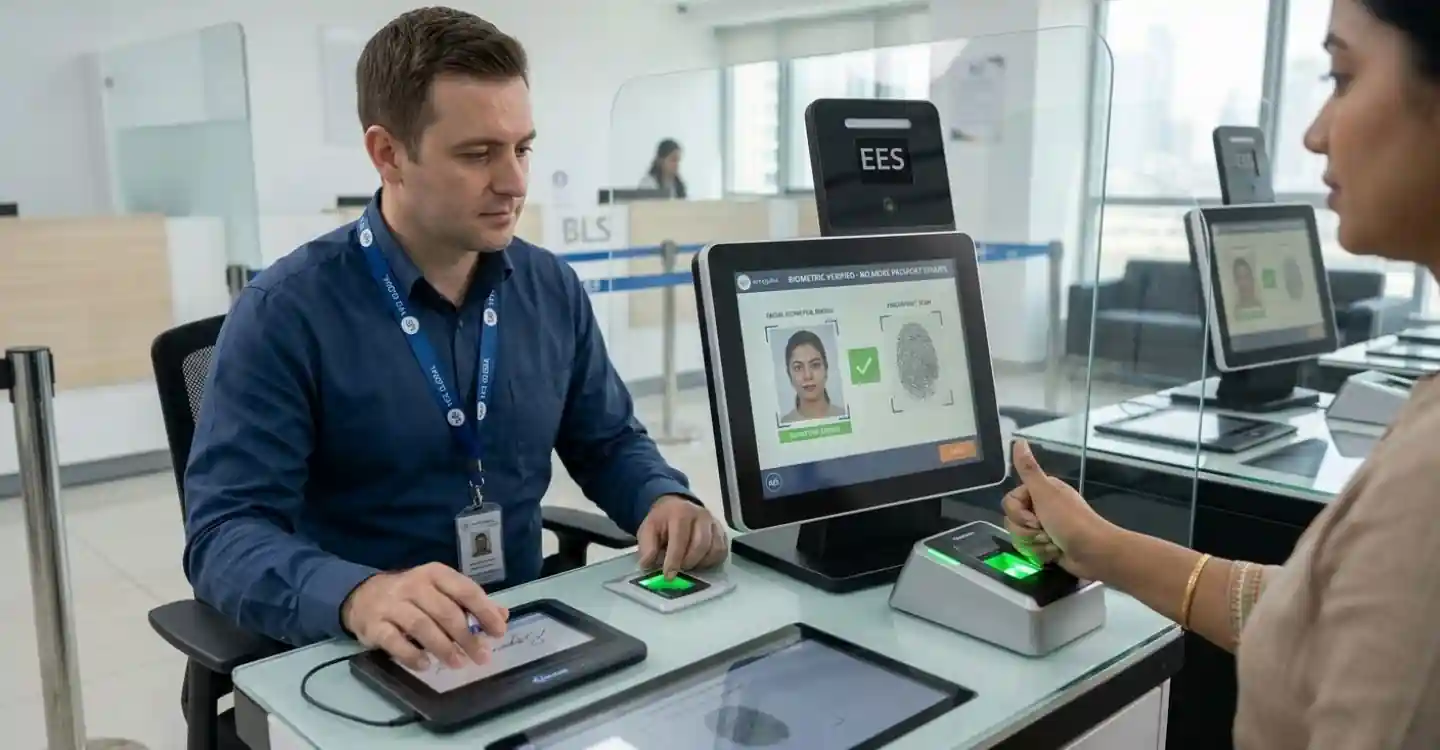
Alongside ETIAS, Europe has fully rolled out the Entry/Exit System (EES). If you are travelling to the Schengen Area in 2026, the biggest change you will notice is at the border control booth.
- No More Passport Stamps: The traditional ink stamps are officially gone. Europe now uses an automated IT system to register your entry and exit digitally.
- Biometric Checks: The first time you cross a Schengen border under this system, you will be required to provide biometric data—specifically fingerprints and a facial image—right at the passport control gate.
- Automated Calculations: This system automatically tracks your days spent in Europe, making it impossible to miscalculate the 90/180-day rule without triggering an immediate alert.
For UAE residents holding a Schengen visa, this doesn’t change your application process in Dubai, but it means your travel history is tracked with absolute digital precision. Overstaying by even a few hours will be instantly flagged.
Destination Strategy: Which is the Easiest Schengen Visa to Get from Dubai?
This is one of the most searched questions in the UAE expat community — and it’s the right question to ask. It’s true that not all consulates process visa applications with the same speed or have the same approval rate, and not all evaluate certain nationalities more carefully than others.
Which Country is Easy for a Schengen Visa for Indian and Pakistani Passports?
For Indian passport holders, these countries have historically offered the most consistent approval experience from Dubai:
- Spain — high approval rates across all applicant profiles, clear documentation requirements, strong tourism infrastructure that processes applications efficiently
- Germany — reliable VFS operations in Dubai, consistent standards, good track record for both first-time and repeat applicants
- Italy — has heavily digitalised its application pre-screening and tracking systems over the last few months. While you still need to physically attend your appointment in Dubai for biometrics and passport submission, the backend digitalisation has notably improved processing speeds and cut down on administrative delays for UAE applicants
- Netherlands — transparent checklist, predictable timelines
For Pakistani passport holders, the bar is a little higher — not impossible, but consulates tend to scrutinise financial documents more carefully and look for detailed itineraries. Spain, Germany and Greece are generally the most workable starting points, provided your file is complete and well-prepared.
Here’s the thing though: “easiest” is relative. A strong, consistent application to any Schengen country will outperform a weak application to the supposedly “easy” one. Country selection matters, but document quality matters more.
Check Which Consulate, Embassy, or Visa Application Centre You Need to Apply To
This one catches a lot of people. Schengen visa applications aren’t submitted to any consulate you like — you must apply to the consulate of the country you are visiting the most.
- If you are visiting just one country, apply at that country’s consulate.
- If you plan to visit more than one country, apply at the consulate of the country where you’ll stay the most nights.
- If you’ll spend the same number of nights in two countries, apply at the consulate of the country you will enter first.
You won’t get a simple delay when you apply at the wrong consulate; you’ll get an automatic refusal. Your application is considered invalid, and the consular fee is not returned. This is one of the most avoidable mistakes we see, and it’s exactly the kind of thing a pre-submission check catches immediately.
In Dubai, applications for most Schengen countries go through one of three visa application centres:
- VFS Global — Spain, Germany, Netherlands, Switzerland, and others
- TLScontact — primarily France
- BLS International — varies by country
What 5 Countries Are Not in Schengen? (The Non-Schengen Traps)
Plan your Europe trip carefully around this. A Schengen visa lets you enter Paris, Amsterdam, and Rome. However, it does not grant you entry into several other highly popular European destinations that require entirely separate visas.
Important Update: If you are reading older travel guides, disregard them. Bulgaria and Romania have fully joined the Schengen Area across all air, sea, and land borders. Your standard Schengen visa is now completely valid there.
| Country | What You Need |
| United Kingdom | Separate UK Standard Visitor Visa |
| Ireland | Separate Irish Short Stay (C) Visa |
| Cyprus | EU member, but not yet Schengen — separate Cyprus visa required |
| Albania | Non-EU/Schengen — separate visa needed (unless you hold a valid multiple-entry Schengen visa) |
| Montenegro | Non-EU/Schengen — separate visa needed (unless you hold a valid multiple-entry Schengen visa) |
Step-by-Step Schengen Visa from Dubai Application Process in Dubai
Schengen visa from Dubai UAE application processes demand absolute precision from the very first document you assemble. To eliminate the risk of a costly rejection and align your travel file with current European consular standards, follow this structured, step-by-step workflow designed for a successful submission.
Step 1: Identify Your Visa Type & Purpose
Most people will need a Type C short-stay visa. This is for trips like fun visits (sightseeing, holidays, seeing family) or work trips (meetings, events, fairs). You can declare both on one application if your trip covers both.
Don’t overthink this step — but do be honest. If you pick “tourism” but then show a letter for a business event, the officers will see the mismatch.
Step 2: Begin Your Online Application & Complete the Form
The application form is the same for all Schengen countries. Most visa centres offer an online version. Fill it out carefully — pay attention to how you enter your name (exactly as it appears on your passport), travel dates, and accommodation addresses.
The single most common form error is inconsistency. Your form says you’re staying at one hotel, but your hotel booking shows a different address. Your form says you earn AED 15,000 per month, but your bank statement shows irregular deposits. Small errors like these can slow or stop your visa from being approved.
Step 3: Book an Appointment at VFS Global, TLScontact, or BLS International Dubai
Once the form is ready, schedule your biometrics appointment at whichever of the visa centres applies, be it VFS Global, TLScontact or BLS International, as it depends on where you’re applying to. Most people stumble at this hurdle.
Appointment slots in Dubai, particularly for France and Spain, are genuinely scarce. Bot-driven booking systems and third-party resellers make the situation worse. Real slots open unpredictably — often early in the morning or mid-week at short notice.
Our team monitors availability in real time. If you’ve been trying to book and keep coming up empty, contact us on WhatsApp—securing an appointment early often determines whether your travel dates are even viable.
Step 4: Visit the Visa Application Centre for Biometric Enrollment
At the Visa Application Centre, present the required original documents as well as a clear copy of the same. Your biometrics will be recorded; your thumb impression and a digital picture will be taken. That will hardly take 10 or 15 mins of time at the centre.
Do you need an interview for a Schengen visa from Dubai? Typically, no. In most cases, from Dubai, applications won’t require an interview. However, the consulates may ask you for an interview at their discretion, especially in the case of new applications or if some clarification on the provided documents is needed. If you are asked to appear for a visa interview, be punctual and respond to the questions directly, and don’t doubt the visa officers; they are just trying to get more information.
Step 5: Track Your Application Status & Collect Your Passport
After submission, keep it tracked at the visa centre using your application reference number on the online portal. Processing will usually take around 10-15 working days but can take up to 3-4 weeks during the summer months (June-August) or during December. When your passport returns to the visa centre, ready for you to collect, examine your visa sticker on the passport before leaving the visa centre.
You should check that you were issued the right visa (single/double/multiple entries) for the correct dates and for the number of days allowed. Things do go wrong sometimes, and it is always easier to fix a visa than to fix things at the border!
If you want to track down specific country embassy rules or read more expert breakdown pieces, make sure to browse through our official Schengen Visa Blog & Guides Dubai where we consistently upload real-time slot alerts and dynamic policy changes.
Schengen Visa Requirements for UAE Applicants: The Document Checklist
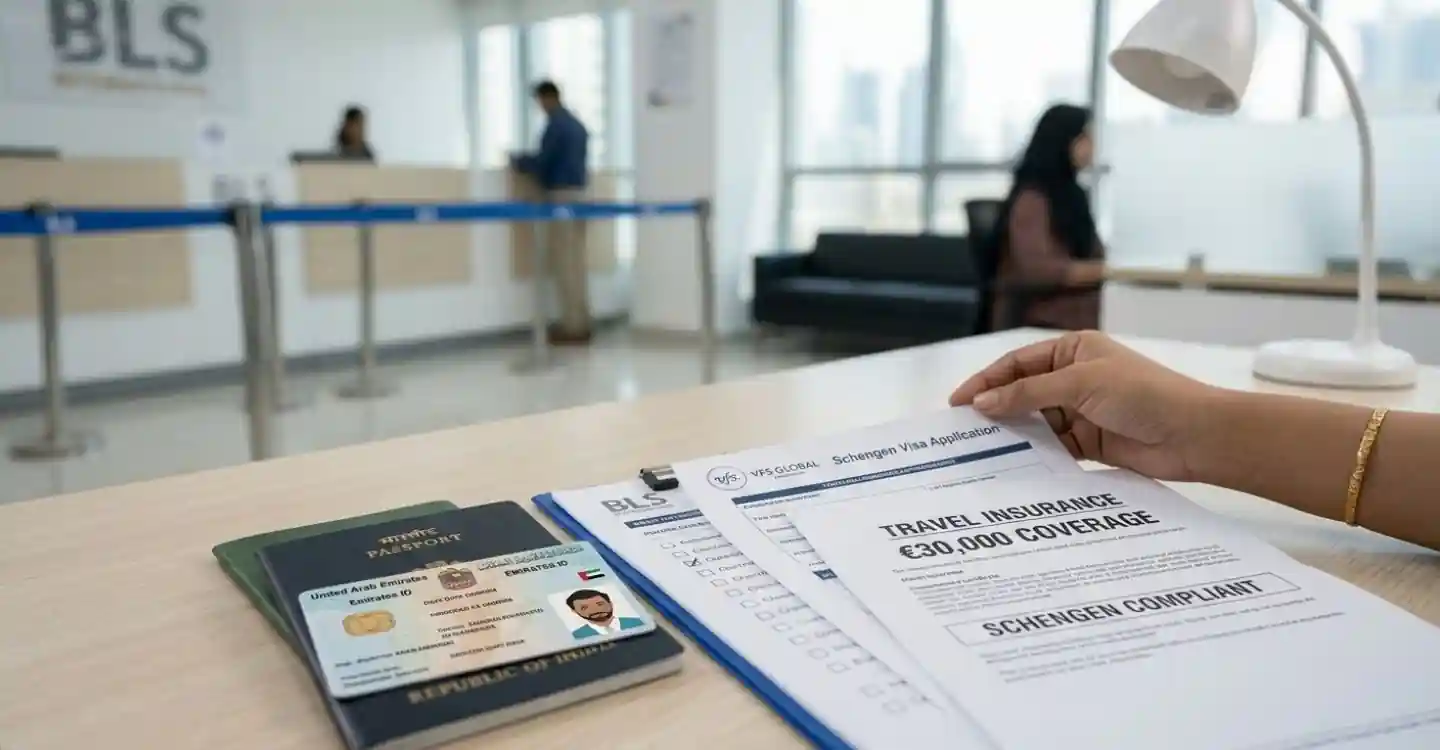
Getting your documents right is honestly half the battle. Consulates don’t reject applications because people are bad travellers — they reject them because something in the file is missing, expired, or doesn’t match something else. The good news is that the Schengen document checklist for UAE residents is predictable. It’s the same core set every time, with minor variations depending on which country you’re applying to. Go through this carefully and get everything in order before your appointment, and you’ll walk in with confidence.
Core Personal Documents & UAE Residency Validity
- Valid passport — minimum 2 blank pages, valid for at least 3 months beyond your planned return date
- UAE Residence Visa — valid throughout the application period, typically 90+ days remaining
- Emirates ID — colour photocopy, front and back
- Recent passport photographs – Schengen specification (white background, 35×45 mm, taken within the last 6 months)
- Completed and signed Schengen Visa Application Form
Schengen-Compliant Travel Insurance Requirements
Travel insurance isn’t optional — it’s a mandatory requirement and a direct rejection point if missing or inadequate.
The minimum standard for Schengen compliance:
- Coverage of at least €30,000 for emergency medical expenses and repatriation
- Valid across all 29 Schengen member states, not just your destination
- Active for the full duration of your stay, including entry and exit dates
One thing to know: most credit card travel insurance policies do not meet these requirements. Read the policy details before assuming you’re covered. If your insurer can’t produce a letter confirming €30,000 coverage valid across all of Schengen, get a dedicated travel insurance policy.
Verifiable Flight Itineraries and Proof of Accommodation
You must present the confirmed flight booking for entry and exit. Most consulates accept a held booking (without full payment) valid for 24–72 hours — sufficient to submit alongside your application.
For accommodation, your stay includes a hotel booking, an Airbnb confirmation or a signed letter of invitation from a European-based host with ID & proof of address.
Here is the critical point: all bookings must be genuine and traceable. Consulate officers run checks. A fabricated or unverifiable hotel booking is a straightforward rejection. If you’ve booked a real hotel, your booking reference should pull up correctly when searched — no shortcuts here.
Crucial Financial Benchmarks: Bank Statements & The "3000 Dirham Rule"
If there’s one part of the Schengen application that trips up Dubai residents more than any other, it’s the financials. Not because the requirements are unreasonable, but because there’s so much bad advice floating around about what consulates actually want to see. The “3,000 Dirham rule” is the biggest example. It sounds logical, it spreads fast on WhatsApp, and it gets people rejected every single week. Let’s clear this up properly.
What is the Minimum Bank Balance for a Schengen Visa from Dubai?
There isn’t a particular magical number that gets published in an official guideline. However, according to the consistent experience after application from the UAE is that, the practical guidelines are as follows:
- AED 15,000–20,000 maintained as a regular balance over the past 3 months
- Roughly €50–€100 per day of your intended stay in Europe — so a 10-day trip means demonstrating capacity for at least AED 5,000–7,000 above your regular monthly expenses
More important than the number is the pattern. Consulates look at 3–6 months of statements. They want to see regular salary credits hitting your account, consistent spending that reflects your lifestyle, and a balance that suggests you can fund a European holiday without stress.
Debunking the Myth: Why the 3000 Dirham Rule Leads to Direct Rejections
Here is a myth that does real damage and refuses to die in UAE expat forums and WhatsApp groups: the “3,000 AED per day rule”.
The idea is that if you deposit AED 3,000 for each day of your planned trip into your bank account before you apply, you’ll meet the financial requirement. So a 10-day trip = AED 30,000 deposited, application approved.
It doesn’t work like that. And it hasn’t worked like that for years.
A large, sudden cash deposit immediately before an application is one of the clearest red flags in bank statement analysis. Consulate visa officers are specifically trained to spot it. What they see is not “this person has money” — what they see is “this person is trying to look like they have money for the purpose of this application.”
What actually convinces a consulate officer:
- Regular salary credits over the past 3–6 months
- Consistent, explainable spending patterns
- A balance that didn’t appear from nowhere two days before the application date
If your bank history is thin or irregular, the right move is to plan your application 3–6 months out and build a genuine financial record — not to manufacture one at the last minute.
Before you submit, have someone who knows what consulates look for actually review your statements. Our document audit service does exactly that. Book a call with us before you spend the €90.
Schengen Visa Fees & Total Costs in Dubai (2026 Updates)
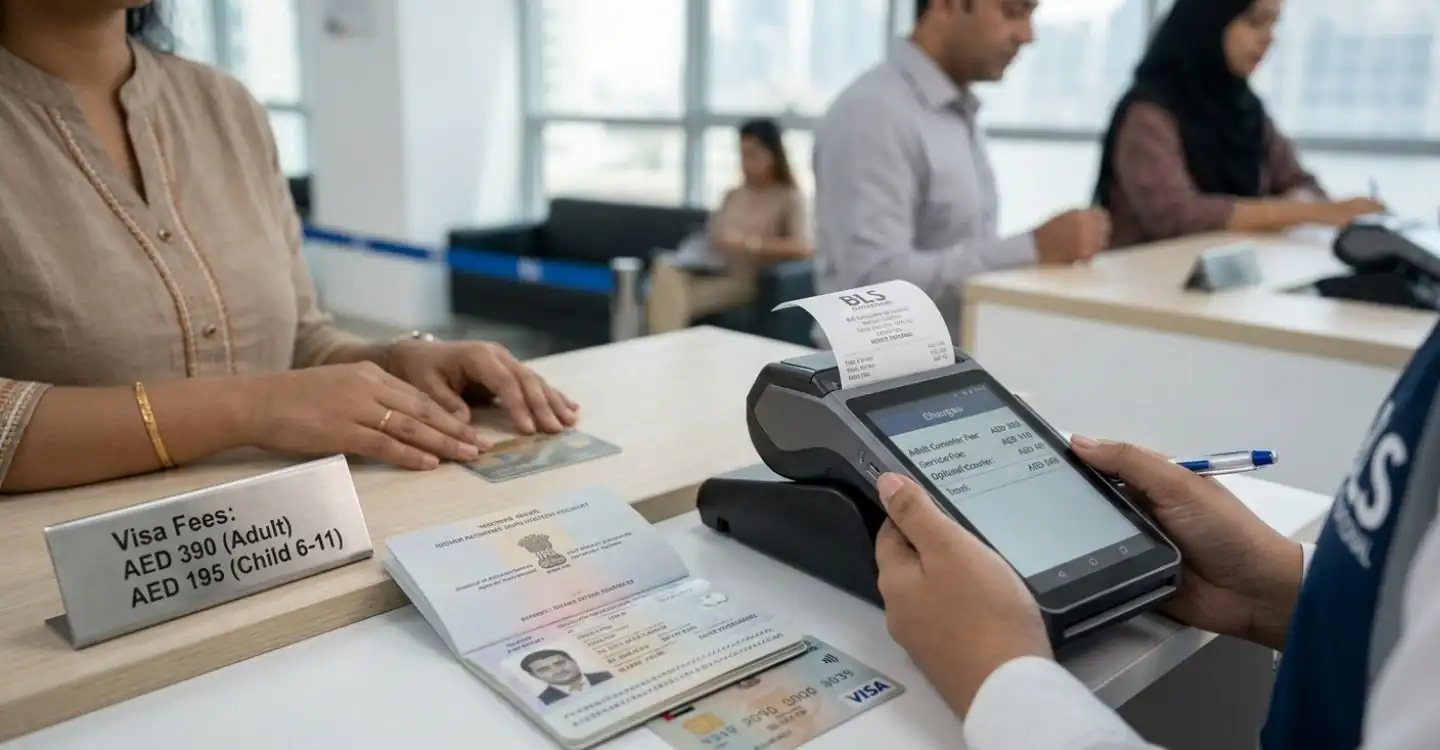
Before you apply, know exactly what you’re paying — and what you’re not getting back if things don’t go your way. The total cost of a Schengen visa application in Dubai is made up of two separate charges: the consular fee set by the embassy and the service fee charged by the visa centre. Both are mandatory; neither is negotiable and neither is refundable. No surprises at the counter if you go in knowing this.
Official Embassy Visa Fees vs. Mandatory Service Centre Charges
Two separate fees apply to every application — and neither is refundable.
| Fee Component | Adult | Child (6–11 years) | Child under 6 |
| Consular Fee | €90 (~AED 390) | €45 (~AED 195) | Free |
| VFS / BLS / TLS Service Fee | ~AED 85–130 | ~AED 85–130 | ~AED 85–130 |
| Estimated Total | ~AED 475–520 | ~AED 280–325 | ~AED 85–130 |
Additional optional services at the visa centre – courier return of your passport, photo capture on-site, and document photocopying – add to this. Exact service fees vary slightly by centre and country. always check current charges on the website of the visa centre before attending your appointment.
Are Schengen Visa Fees Refundable in Case of Rejection?
No. The consular fee is a file review fee, not a payment for an approved visa. Whether your application is approved, rejected, withdrawn, or deemed incomplete—the fee is not returned. This is stated clearly by every Schengen consulate.
This is why preparation matters so much. A €90 loss sounds manageable. But add the cost of held flights that expire, hotels that can’t be cancelled, and the time spent starting the process over – and the real cost of a preventable rejection is considerably higher.
The 2026 Long-Validity Shift: The Schengen "Cascade" Regime Explained
Most people applying for a Schengen visa don’t realise they may already be eligible for a 2-year or even 5-year multiple-entry visa — and consulates are now legally required to issue one if you qualify. This is one of the biggest recent changes to Schengen policy, and it’s particularly relevant for long-term UAE residents who have been quietly building a clean travel record. Here’s what the cascade system is and how to make it work for you.
How to Secure a 2-Year or 5-Year Multiple-Entry Schengen Visa from the UAE
The cascade system requires consulates to issue progressively longer visas to applicants who demonstrate a track record of compliance. It’s not a reward — it’s now an obligation under the visa code. The progression looks like this:
| Your History | Visa You Should Receive |
| First or second Schengen application | 1-year multiple-entry visa |
| After that, clean travel history | 2-year multiple-entry visa |
| After that, continued compliance | 5-year multiple-entry visa |
The conditions:
- All previous Schengen visas must have been legally obtained and used without overstay or violations
- You must apply within 3 years of your last visa’s expiry date
- The consulate retains some discretion on supporting documents
For Indian passport holders living in the UAE — one of the largest applicant groups in Dubai — this is a meaningful upgrade. After just two compliant visa cycles, you could qualify for a 2-year multiple-entry Schengen visa. That’s two fewer application fees, two fewer sets of documents, and two fewer appointment slots to fight over.
One important caveat: the cascade system is required by law but isn’t applied uniformly by every consulate. Some are more consistent than others. If you believe you qualify for a longer-validity visa based on your travel history and aren’t getting it, we can help you document and present your eligibility correctly. Talk to us.
Common Issues & Rejection Reasons Faced by Dubai Residents
Here are the 5 (or so) reasons behind the vast majority of visa rejections by applicants using Dubai, UAE-based processing – and they are no real surprises.
- Document inconsistencies are the most common. Your application form, employer letter, bank statement, and hotel booking should all tell the same story. Different figures, different addresses, or different dates across documents raise immediate doubts about the authenticity of your file.
- Suspicious finances come second. This covers both genuinely insufficient funds and the manufactured balance problem described above. A thin bank history, no regular salary credits, or a sudden large deposit shortly before application — any of these will attract scrutiny.
- Weak ties to the UAE are the third. Consulates need confidence that you intend to return to Dubai after your trip. If your employment contract is about to expire, your tenancy agreement is months stale, or you have no clear reason to come back — your application is weaker for it. An NOC (No Objection Certificate) from your employer isn’t always required, but it strengthens your case considerably and costs nothing to produce.
- The wrong consulate is the fourth – and the most avoidable. As covered above, the main destination rule is strict. Submitting to the wrong consulate results in an automatic administrative rejection. No appeal on merit, no refund.
- Inadequate travel insurance is the fifth and perhaps the simplest to fix. If your policy doesn’t meet the €30,000 Schengen-wide requirement, your application is incomplete. Check before you submit.
All five of these are catchable before your file reaches the consulate. Our pre-submission audit reviews every document in your package against the specific requirements of your target country. Book an audit here.
FAQ About How to Apply for a Schengen Visa from Dubai
Which is the easiest Schengen visa to get from Dubai for Indian and Pakistani passport holders?
What is the minimum bank balance required for a Schengen visa from Dubai?
What is the “3000 Dirham Rule” and why does it cause visa rejections?
Can I travel to Europe visa-free if I have a valid UAE Residence Permit or Emirates ID?
How much does a Schengen visa cost in Dubai, and can I get a refund if rejected?
What is the Schengen 90/180 rule and how does it calculate my stay?
What 5 major European countries are not part of the Schengen Area?
How long does the Schengen visa application process take in the UAE?
What is the new Schengen “Cascade” rule and how can I get a 2-year multiple-entry visa?
Is ETIAS the same as a Schengen Visa, and do UAE expats need it?
Ready to Apply for Your Schengen Visa from Dubai? Let Us Handle the Paperwork
You now know more about the Schengen visa process than most people who apply. But knowing what’s required and making sure your file actually reflects it are two different things. One overlooked document, one inconsistent figure, one wrong consulate — and your €90 is gone with nothing to show for it. That’s where we come in. Our experts have helped hundreds of UAE residents get their Schengen visa approved without the stress, the guesswork, or the rejected stamps.
Why Risk a Rejection? Get Your Documents Audited by Experts Today
Our team at Schengen from Dubai works with UAE residents across every nationality and every Schengen destination. We know what Spain’s consulate looks for that Germany doesn’t. We know how to present bank statements for applicants with commission-based income. We know when an NOC will make or break an application.
What we offer:
- Full document audit tailored to your nationality and destination country
- Bank statement review with specific feedback — before you submit
- Appointment booking support across VFS Global, TLScontact, and BLS International Dubai
- End-to-end application management for those who want hands-off support from start to finish
Book a Consultation or Connect with Our Team via WhatsApp
Whether you are a first-time applicant or wanting to know what went wrong with a past rejected application, we are here to assist.

About