

Visa-Free Countries for UAE Residents (2026 Complete Guide)

Table of Contents
UAE residents can travel visa-free or obtain a visa on arrival to popular destinations, including Georgia, Armenia, Azerbaijan, and the Maldives, provided they hold a valid residence permit and passport. While a UAE residence permit unlocks simplified entry rules for specific countries, your home-country passport remains the primary factor in determining entry requirements, maximum stay durations, and mandatory documents like travel insurance or return tickets.
Note: A UAE resident visa cannot replace a passport. The free-entry privilege may change based on your passport.
Always verify rules for your passport, nationality, minimum passport validity, return ticket, and hotel accommodation bookings before booking any other flights.
In this 2026 guide, I will cover visa-free countries that offer visas on arrival, free stay periods, electronic visas, and more.
Let me start with what visa-free entry means for UAE residents.
What Does "Visa-Free for UAE Residents" Mean?
A free visa for UAE residents means they can travel without needing a visa in advance. These countries allow a visa-free stay for a set period.
International or bilateral agreements determine how long a UAE resident may stay without a visa.
Visitors must observe these permitted stay days to avoid penalties, including fines, legal issues, or future restrictions.
This is how it works: a traveller enters a country without a visa or obtains a visa at the point of entry.
This applies to residents (foreign expats residing in the UAE) but is completely different from holders of a UAE national passport (held by Emirati citizens).
Difference Between Visa-Free, Visa on Arrival (VoA), and eVisa
The difference between visa-free, visa on arrival (VoA), and eVisa mainly comes down to timing.
Visa-free entry means you don’t need a visa or prior approval to enter a country. All a traveller needs to do is show a valid passport at the border. You will also be required to show a return ticket.
While there is no fee, a border officer may still deny you entry if they suspect you are breaking rules or are likely to break immigration rules.
A visa on arrival is when a traveller requests and receives a visa at the point of entry, such as at an airport or land border.
The traveller fills out a form, shows the required documents, and pays the visa fees, often in cash and in a specific currency, at the arrival desk.
In reality, you may face long queues, and it can be even more disappointing if you are denied entry because you lack required documents.
Then, an eVisa is a digital visa. A traveller applies online and receives the visa online (eVisa) before leaving their country of residence.
With an eVisa, you also pay online and know you’ve been approved before buying a ticket and taking your flight.
Visa-Free Entry vs. Visa Exemption: Essential Travel Rules
Visa-free entry and visa exemption differ: visa-free entry does not require a traveller to apply for a visa, nor does it require prior approval or fees. A traveller just arrives at the border, and immigration officers stamp their passports.
A visa exemption often means visa-free entry. Still, technically, it refers to specific legal arrangements or bilateral agreements in which a country explicitly exempts certain nationalities from needing a visa to enter.
Therefore, the essential travel rules that border control officers require to stamp your passport are as follows:
- You must have a valid passport for at least six months past your arrival date.
- You must have evidence of a return ticket or proof of a return ticket that clearly shows you will exit the country.
- Border agents may ask for a bank statement or other financial proof that you can comfortably afford your intended stay.
- Even when you are visa-exempt, some nationals will require an electronic travel authorization (like an ETA or eTA) linked to their passport.
Top Visa-Free Countries for UAE Residents in 2026
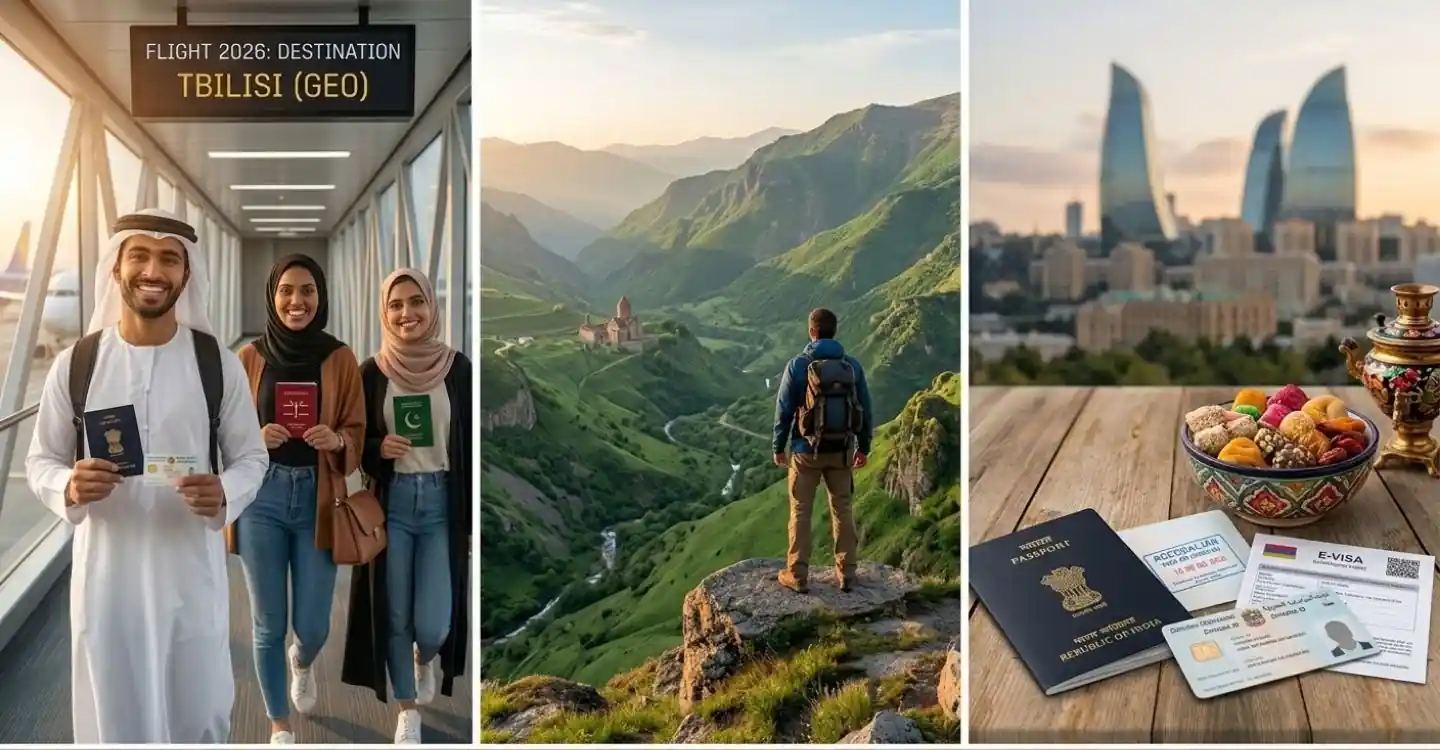
UAE residents can travel to as many countries as they like, but the top visa-free countries for UAE residents in 2026 are as follows:
- Georgia: Visa-free entry for up to 90 days or more for most UAE residents (note the mandatory health/accident insurance requirement).
- Armenia: Simplified or visa-free entry for valid UAE residency holders.
- Azerbaijan: Easy visa-on-arrival or simplified e-visa options for UAE residents.
- Seychelles: Visa-free entry upon arrival with a valid passport and UAE residency.
- Maldives: Visa-on-arrival for up to 30 days for general travellers.
- Montenegro: Seasonal visa-free entry for eligible UAE residents under specific conditions (such as direct flights and a 3-year valid UAE residence permit).
- Kyrgyzstan: Visa-free or simplified entry for stays up to 30 days for valid UAE residents
TIP: Your home-country passport remains the primary factor in determining whether you get visa-free access. UAE residency only provides an extra benefit rather than replacing your passport. Make sure your Emirates ID and passport are valid for at least 6 months before booking.
Azerbaijan – Up to 90 Days Visa-Free
If you hold an ordinary passport from Belarus, Georgia, Kazakhstan, Russia, Turkey, and Ukraine, you may visit Azerbaijan visa-free for up to 90 days.
Other countries that also enjoy up to 90 days visa-free entry to Azerbaijan are:
- Albania
- Belarus
- Georgia
- Kazakhstan
- Kyrgyzstan
- Maldives
- Moldova
- Morrocco
- Russia
- Serbia
- Tajikistan
- Turkey (Türkiye)
- Ukraine
- United Arab Emirates
- Uzbekistan
Note: China allows up to 30 days per entry, up to a cumulative 90 days in 180 days, and Qatar permits a 30-day stay. You can check the official details and updates directly through the Ministry of Foreign Affairs of Azerbaijan.
Malaysia – Up to 30 Days Visa-Free
In Malaysia, travellers from specific countries, including India and China, can enter visa-free for up to 30 days for tourism and social visits until the end of December.
Recently, authorities cautioned travellers against using these 30 days to seek employment, as they risk detention and deportation.
No extension is available after the 30 days have elapsed under the tourism visa status.
During this period, permitted activities include tourism, transit, social visits, and business meetings.
Mandatory Documents
- Passport valid for at least six months
- A confirmed return ticket
- A confirmed hotel booking
- Online proof of Malaysia Digital Arrival Card (MDAC) submission before arrival.
Maldives – Up to 30 Days Visa-Free
Most nationalities don’t need advance applications or visas and are offered a free 30-day stay in the Maldives.
To get this 30-day stamp, travellers need a valid passport with at least one month remaining until expiry, though the recommended and acceptable period is six months.
You must also provide proof of financial stability and a prior accommodation booking. The estimated proof of financial stability is $100 plus $50 per day.
In addition to a return ticket, a traveller must complete the Traveller Declaration (IMUGA) and submit it electronically within 96 hours before the flight.
Unlike Malaysia, travellers can extend their tourism stay for up to 90 days through the Maldives Immigration Department.
Overstaying your visa will still result in heavy fines and deportation. The entry stamp is strictly for tourism and not a permit for local employment.
Georgia & Armenia – Entry Rules for UAE Residence Permit Holders
In Georgia & Armenia, the general rule is that most UAE residents can enter visa-free for up to 90 days within 180 days, as long as their UAE residence permits and passports are valid at both entry and exit.
If you hold passports from countries like Pakistan, Bangladesh, Uganda, Sudan, or Syria, your UAE residency permit must be multiple-entry and valid for at least one year from your entry date.
If not, you must pay for a C1 tourist visa in advance.
Travellers must also carry valid health and accident insurance with a minimum coverage of 30,000 Georgian Lari (GEL).
Border officials may also ask for an Emirates ID, proof of accommodation, a return flight ticket, and bank statements.
For UAE residents with supporting documents and a valid residency permit, Armenia is granting them free entry and a visa on arrival from July 1st, 2023, up to July 1st, 2027.
Visa-Free Countries for UAE Residents with Indian Passport
If you have an Indian passport and are a UAE resident, you can travel visa-free or obtain a visa on arrival to several destinations.
Below are the most popular visa-free and visa-on-arrival destinations.
- Azerbaijan offers travellers a visa on arrival for qualified UAE residents
- Thailand is visa-free for eligible Indian passport holders
- Malaysia offers visa exemption for Indian nationals
- Armenia offers UAE residents visa-free access for at least 6 months, with visa-free access up to 180 days.
- Kazakhstan offers travellers a visa-free stay for up to 14 days per visit
- Georgia allows entry for up to 90 days for travellers with UAE resident permits
- Uzbekistan also offers visa-free entry for specified short stays
- Kyrgyzstan offers visas on arrival at major entry airports like Manas International Airport
- GCC Neighbours (Bahrain, Kuwait, Oman, Qatar) offer specific visa-free or visa-on-arrival options for eligible GCC/UAE residents.
- Maldives, Seychelles & Mauritius are popular island getaways offering visa-free options on arrival.
- Azerbaijan offers travellers a visa on arrival for qualified UAE residents
- Thailand is visa-free for eligible Indian passport holders
- Malaysia offers visa exemption for Indian nationals
Visa-Free & Entry Permit Destinations for Indian Passport Holders
Indian passport holders have visa-free access or may obtain visas at entry points for approximately 27 visa-free countries and more than 50 other destinations.
The top visa-free destinations and limited stays include:
- Nepal offers unlimited stays for travellers with a valid Indian passport or voter ID.
- Bhutan requires an entry permit on arrival, using a passport or valid voter ID, for visa-free entry.
- Thailand offers up to 60 days of visa-free stay for tourists
- Malaysia offers up to 30 days of visa-free entry and stay for tourists
- Maldives has up to 30 days of visa-free access on arrival
- Indonesia has up to 30 days visa-free for tourism
- Fiji offers 120 visa-free days
- Seychelles issues visitor permits on arrival for up toto30 days
- Dominica offers up to 6 months of visa-free access and stay
- Jamaica is visa-free for tourism
- Grenada offers 90 days of visa-free entry and stay
Note: Travelers must have a valid passport for at least 6 months from the date of entry. Travelers also need supporting documents like return tickets, proof of accommodation, and evidence of sufficient funds and upkeep for their stay. Immigration officers verify all of this at entry.
Visa on Arrival & eVisa Countries for Indian Expats in UAE
Indian Expats in the UAE with Indian passports and a valid UAE residency (Emirates ID) qualify for visa-free entry or visa on arrival.
Alternatively, Indian expats in the UAE with Indian passports can also access e-visas to several popular international destinations.
Below are popular visa-free and visa-on-arrival destinations for UAE-based Indians.
| Country / Destination | Entry Type | Max Stay Duration | Key Requirements / Notes |
|---|---|---|---|
| Georgia | Visa-Free | Up to 1 year | Valid UAE residence visa and passport. |
| Armenia | Visa on Arrival / Entry Access | Up to 180 days | Valid UAE residency / Emirates ID. |
| Azerbaijan | Visa on Arrival | Varies (short stay) | Eligibility may apply to Indian passport holders who are UAE residents. |
| Kazakhstan | Visa-Free | 14 days | Check current entry rules for Indian passport holders residing in the UAE. |
| Thailand | Visa-Free / VoA | 15 to 30 days | Entry conditions depend on current rules for Indian passport holders. |
| Maldives | Visa on Arrival | 30 days | Generally requires a return ticket and confirmed accommodation. |
| Seychelles | Visitor Permit | Up to 90 days | Generally requires confirmed accommodation and a return or onward ticket. |
Special Visa Privileges for Indian Passport Holders with US, UK, or Schengen Visas
Privileges for Indian passport holders with US, UK, or Schengen visas fall into three categories.
Most nations offering these privileges trust the background screening already carried out by US, UK, or EU authorities.
Countries like Mexico, Guatemala, and Panama offer up to 30 days of visa-free entry or visas on arrival for travellers with a valid US visa, especially if the US visa is a multiple-entry visa and the traveller has previously visited America.
Travellers with a valid UK visa also receive visa-free entry or visas on arrival under specific conditions.
Countries like the Bahamas and Panama offer up to 30 days for a UK visa, and Oman and the UAE offer visas on arrival.
Travellers with a valid Schengen visa can enter Serbia, Albania, Montenegro, Georgia, and microstates like Monaco and Vatican City visa-free or with a visa on arrival.
Travellers must meet conditions such as a valid passport, a valid Schengen visa, and a multiple-entry visa.
In addition, travellers must carry proof of onwards travel, hotel bookings, and sufficient funds.
Visa-Free Countries for UAE Residents with Pakistani Passport
Any traveler with a Pakistani passport and a valid UAE residency visa can travel to a select group of countries with visa-free entry, visa on arrival, or an eVisa.
Note that even with a UAE residency, it does not override a Pakistani passport in some destinations.
The popular visa-free and visa on arrival destinations for travelers with Pakistani passports and residents of the UAE include:
Maldives offers a visa on arrival for up to 30 days, while Sri Lanka offers electronic travel authorization before flying to another country.
Destinations like Dominica offer visa-free entry for up to 6 months, while Azerbaijan offers a visa on arrival. UAE residents can also use the eVis option.
Qatar offers visa-free entry for qualified UAE residents with a valid professional/residence status, while Nepal offers a visa on arrival at its airport.
Travelers must have a valid passport valid for at least 6 months from their travel date, along with supporting documents such as a UAE residency visa and proof of financial stability.
Visa-Free Destinations for Pakistani Passport Holders
Pakistani passport holders can visit many destinations with visa-free entry and stay, a visa-on-arrival system, or an eVisa system.
Visa-Free Destinations
The following countries allow Pakistani passport holders to enter visa-free.
- Barbados allows entry for up to 90 days
- Dominica allows entry and stay for up to 180 days
- Haiti allows entry and stay forup too 90 days
- Both Micronesia and Rwanda allow entry and stay for up to 30 days
- St. Vincent and the Grenadines allow entry for up to 30/90 days
- Trinidad and Tobago allows entry into their country for up to 90 days
- And Vanuatu allows entry for up to 30 days
Visa on Arrival (VoA) and Electronic Travel Authorization (eTA)
Other countries that allow entry before offering a visa on arrival and an electronic travel authorization include the following.
Maldives offers a visa on arrival or a visitor permit
Nepal offers a visa on arrival in their country
Cambodia and Qatar offer visas on arrival in their country
Comoros, Cape Verde, and Guinea-Bissau offer a visa on arrival.
Both Kenya and Sri Lanka prefer electronic travel authorizations for entry.
Note: Holding valid, multi-entry visas or residency permits from major regions like the Schengen Area, the US, the UK, Canada, or GCC states can sometimes unlock additional eVisa or VOA privileges in other countries. Immigration rules and entry requirements change frequently, so always verify policies with the destination country’s official embassy or immigration portal before booking travel.
Visa on Arrival & eVisa Countries for Pakistani Expats in UAE
If you are a Pakistani Expat in the UAE, below are the countries you can visit with a visa on arrival and the countries you can visit with an eVisa.
Visa on Arrival (VoA) Destinations
- Georgia offers visa-free or VoA entry for up to one year for UAE residents with a Pakistani passport.t
- The Maldives offers more than 30 days of visa-free entry on arrival for all nationals, including Pakistan passport holders.
- Armenia offers a visa-on-arrival option or an electronic visa for holders of a valid UAE residence visa.
- Seychelles & Mauritius offer a specific duration visa-free entry for UAE residents.
- Azerbaijan & Turkey offer a simplified online eVisa system that processes quickly for eligible travelers.
Other General Requirements
- A valid Pakistani passport with at least 6 months remaining validity
- A physical or digital Emirates ID and valid UAE residence visa page
- Return flight ticket and confirmed hotel booking
Visa-Free Countries for UAE Residents with a Philippine Passport
Travelers with a Philippine passport can also visit multiple destinations with visa-free entry and stay, or visa-on-arrival options, based on their nationality and country of residency.
These visa-free and visa-on-arrival destinations include the following:
- Oman offers visa-free entry or a simplified entry for GCC residents for up to 14 days
- Georgia offers visa-free entry for specific UAE residency holders or standard Philippine passport rules, depending on the exact date.s
- Armenia offers visa-on-arrival basis for select categories
- Maldives offers visa on arrival for up to 30 days (applies to general Philippine passport holders)
- Sri-Lanka offers electronic travel authorization or visa on arrival for travelers to their country.
- Nepal offers a visa on arrival, while Seychelles offers a visitor permit on arrival.
Your Philippine passport must be valid for at least 6 months, and you must have supporting documents. This may include a physical Emirates ID, a valid UAE residence visa page, a return ticket, and hotel bookings.
Visa-Free Destinations for Philippine Passport Holders
Philippine passport holders can travel to around 44 to 66 destinations globally, depending on whether visa-free, visa-on-arrival, or electronic entry is included.
Popular visa-free destinations in Asia include, but are not limited to:
- Singapore, which offers up to 30 days’ stay in the country
- Thailand offers up to 60 days (under updated policies)
- Malaysia offers up to 30 days, while Indonesia offers a traveller upto 30 days of visa entry and stay
- Vietnam also offers up to 21 days, while Hong Kong offers up to 14 days of visa entry and stay.
- Taiwan offers up to 14 days (extended through July 31st, 2027)
- Macao offers up to 30 days of visa-free entry and stay, while Brunei offers up to 14 days of visa-free entry and stay in their country
And, popular visa-free destinations in the Americas and Caribbean include the following:
- Brazil offers up to 90 days of visa-free entry and stay
- Peru offers between 90 days to180 days of visa-free entry
- But Colombia, Barbados, and Bolivia offer visa-free access up to 90 days
Tips: Ensure your passport is valid for at least 6 months beyond your date of arrival, and carry proof of a return ticket and hotel bookings, as immigration officers may request them.
Visa on Arrival & eVisa Countries for Philippine Expats in UAE
Filipino expats in the UAE can travel to different destinations of choice and pay for visas on arrival or an eVisa.
Since June 2026, the UAE has expanded its visa-on-arrival program for Philippine passport holders.
If you are a Filipino traveling to select countries that offer visas on arrival or eVisas, you must hold a valid residency permit, visa, or green card from the US, UK, EU member states, Australia, Japan, Singapore, South Korea, or New Zealand.
The 14-day visa costs AED 100 and can be extended once for an additional 14 days for AED 250.
A 60-day visa costs AED 250 and is a non-extendable single stay.
Note that overstay fines cost AED 50 per day starting the day after your visa expires.
General Travel Destinations for Philippine Expats in UAE
Depending on your specific UAE residency status and Philippine passport, destinations offering visa-free entry or visa on arrival vary widely.
Popular regional getaways with simplified entry for UAE residents include places like Georgia, Azerbaijan, and various Southeast Asian or Central Asian hubs (such as Almaty and Astana). However, exact rules depend on whether you hold a standard Philippine passport alone or specific supporting multi-entry visas.
Special Category: Visa-Free Countries for UAE Golden Visa Holders
If you are a UAE Golden Visa holder, you can travel to more than 140 destinations without a visa, or you may obtain a visa on arrival at the border or airport.
The most popular destinations for UAE Golden Visa holders are:
- Armenia, where eligible UAE residents are visa-free or secure eVisas before entry to 150 countries
- Georgia is a visa-free country for UAE Golden Visa holders, or they may acquire a visa on arrival
- Malaysia offers short-term stays of up to 30 days
- Maldives offers visa on arrival for up to 30 days
- Mauritius offers visa-free entry for up to 90 days. Seychelles offers visa-free entry for short tourist stays
- Thailand offers visa-free entry or visa-on-arrival access for up to 30 days
Note: Your nationality determines the exact rules that apply to you on your trip; the Golden Visa normally enhances your long-term residency freedom in the UAE and makes returns easier.
The Gulf Cooperation Council (GCC) countries, including Saudi Arabia, Oman, Qatar, Bahrain, and Kuwait, offer simplified entry or visa-on-arrival rules for UAE residents.
Exclusive Entry Privileges for Golden Visa Holders
Golden Visa holders enjoy many privileges, including a 6-month multiple-entry preliminary visa and the freedom to stay outside the country indefinitely without invalidating their residency.
The initial six-month entry visa allows applicants to complete residency procedures.
Unlike standard residency visas that expire after six months abroad, Golden Visa holders can remain outside the UAE for as long as they wish without losing their status.
The Golden Visa is self-sponsored, giving you full independence to live, work, and study abroad.
Golden visa holders can also sponsor family members of any age and an unlimited number of domestic helpers.
Why Visa Rules Can Be Confusing for UAE Residents
The UAE government frequently changes its visa policy to align with its economic goals, which can confuse travelers.
The United Arab Emirates (UAE) uses visa reforms as economic levers to attract talent, leading to adjustments in its advanced visa system.
The introduction of tracks like Green visas, remote work permits, and expanded Golden visas creates distinct rules for different groups.
Residents normally assume their visa remains active until its printed expiry date, unless otherwise indicated. If a traveler stays outside the UAE for more than 180 consecutive days, their standard residency may automatically cancel or become invalid.
Long-term visa categories, like Golden visa holders, have a more flexible absence limit, which often confuses.
If you are a Golden visa holder and intend to sponsor family members, note that it involves a strict salary threshold, mandatory health insurance standards, and changing local guidelines.
The requirements for tourist entry, employment, and self-sponsored long-term stay vary sharply, which confuses applicants.
Passport Nationality vs. Residence Visa Status
A nationality passport defines who you are and where you come from. It defines your nationality and citizenship, while your residency visa status merely gives you temporary or permanent permission to live in a specific place or country.
A national passport legally defines where you belong as a nation and is usually obtained by birth, descent, or naturalization.
We use passports for international travel for life unless revoked or denounced.
A passport also permits you to vote or run for political office in a country.
A residency visa status permits you to live, work, or study within the borders for a specific time in the country that issued it.
It is normally temporary and conditional and must be renewed periodically as regulated.
Unfortunately, it does not permit you to vote or be elected to political office in that country.
Constantly Changing Rules & Local Immigration Policies
When a country keeps changing its local immigration policies and rules, it creates confusion for migrants, employers, and legal practitioners.
To understand what drives these policy changes, travelers and legal practitioners must watch for administrative shifts that update processing rules or introduce enforcement priorities without a clear transition timeline.
Another driver of these policy changes is the application backlog. When a backlog of applications strains agency resources, agencies often slow adjudication or introduce new ways to address it, leading to changes in visa policy.
Beyond creating uncertainty for applicants, employers often struggle to stay compliant when hiring talented foreign nationals, especially under shifting regulatory frameworks.
Changing asylum standards and border enforcement tactics also disrupt protection networks for displaced populations.
Required Documents for UAE Resident Visa Holders Traveling Abroad
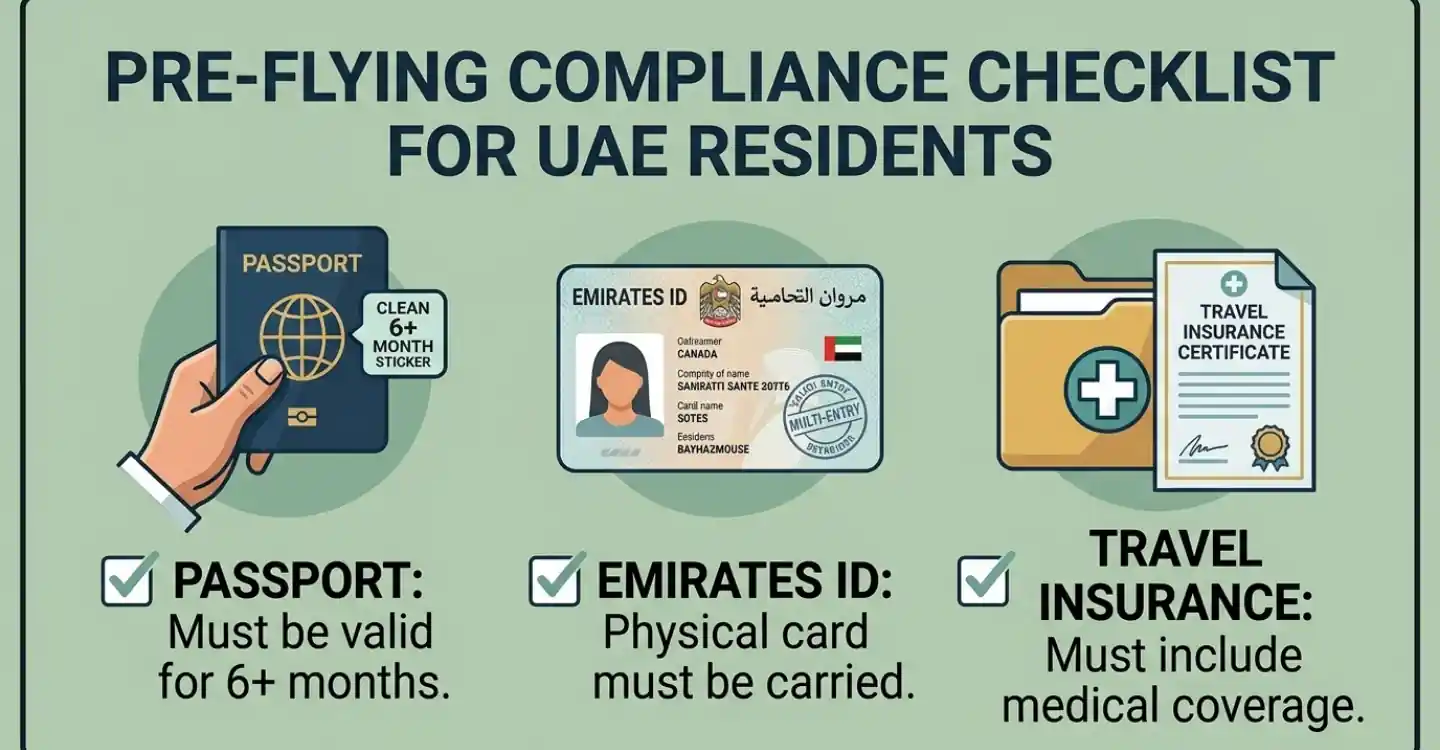
All UAE resident visa holders travelling abroad must carry their original passports valid for at least six months, a valid Emirates ID, and a printed or digital copy of their residence visa files.
If a traveller extends their stay, the standard UAE residence visa automatically becomes invalid if the traveller stays outside the country for more than 180 consecutive days (6 months).
If a traveller exceeds 180 days abroad for work, studies, or medical reasons, you must apply for a digital re-entry permit via the ICP Smart Service Portal before boarding a return flight.
Documents Required for Visa-Free Destinations
Travelling to a visa-free destination may not require a visa, but it will require several essential documents.
A traveller must have a valid passport and, if required, a valid visa. Your passport must be valid for at least 3 to 6 months beyond your planned departure date and have blank pages for stamps.
You also need a return ticket as proof that you have a flight booked to leave the country before your allowed visa-free duration expires.
Hotel reservations are another essential document, such as a rental agreement for where you will live or a letter stating that you are staying with relatives or friends.
A recent bank statement is also required as proof of sufficient funds to support yourself abroad during your stay.
Travel insurance is another essential document, as it provides medical coverage and is mandatory under your destination’s standard border protocol.
Also supporting travel documents like an event ticket, business meeting itinerary, or conference registration that immigration officers may request.
Documents Required for Visa on Arrival (VoA) & eVisa
To get a visa on arrival or an eVisa, you need a few essential documents.
Documents required for a visa on arrival include a passport, return ticket, evidence of payment, and an arrival card.
- Your passport must be valid for at least 6 months from your arrival date.
- You must have a return ticket as proof of a confirmed flight back to your country of residence.
- You must provide evidence of payment, such as receipts, at the airport or seaport.
- An arrival card is a completed digital declaration from the official platform.
The documents required for an electronic visa on arrival (e-VOA-Online) include a scanned passport, digital photograph, outbound ticket, an active email, and evidence of payment (receipts).
- A scanned copy of your passport with full biodata (JPG, JPEG, or PNG format, maximum 200 KB) with at least 6 months’ validity.
- A recent passport-style photo meeting the same digital file specifications
- A return ticket as proof of flight from the country back to your country of residence
- An active email is required to receive your account activation details and the final downloadable e-VOA PDF.
- Proof of payment by Visa, Mastercard, or another credit/debit card enabled for international transactions.
General Checklist (Passport Validity, Emirates ID, Travel Insurance)
If you are a traveller, you must ensure your checklist meets key standards for documents like your passport and insurance coverage.
Passport Validity
- Must be valid for at least 6 months from your date of entry
- Must include a clear, high-resolution scanned biodata page
- Must have sufficient blank pages for entry stamps
Emirates ID
- Mandatory official identity card
- Can not be applied for until your residence visa is approved and stamped
- Visitors and tourists do not need an Emirates ID. They rely on their passport and entry visa/stamp.
Travel Insurance
- A valid medical travel insurance covering emergency health services.
- Keep digital and printed copies of your policy certificate with your travel documents until you exit the country.
Important Travel Tips & Rules Before Flying
These tips from our Schengen visa experts help reduce the chances of rejection or costly mistakes.
Documentation and Booking Rules
- Ensure your passport is valid for at least 6 months past your departure date.
- Verify visa requirements and confirm and apply for any needed destination visa before purchasing your ticket.
- Make sure the name on your ticket matches your government-issued ID or passport exactly.
- Check your flight status online or through your airline’s app before leaving home to catch last-minute changes or cancellations.
Packing and Luggage Rules
- Weigh your bags at home to ensure they fit within your airline’s baggage fees.
- Weigh your carry-on bags to ensure they fit within your airline’s size rules.
- Keep your essentials, like medication, electronics, and important travel documents, in your carry-on bag rather than in checked luggage.
- Keep liquids, gels, and aerosols in small containers inside a clear, easy-to-reach bag.
Airport Timing
- Arrive early: get to the airport at least two hours before domestic flights and three hours before international flights.
- Check in digitally and download your airline’s app to check in 24 hours early and skip long terminal lines.
Essential Checklist Before Booking Your Flight
Use a checklist before booking any flight. This ensures you verify your passport’s validity, check destination visa rules, and compare airline baggage fees.
Essential Booking Steps
- Check your passport validity for at least 6 months past your return date.
- Research visa and entry requirements for your destination country.
- Confirm baggage rules and extra fees, since the cheapest ticket may not include luggage.
- Confirm exact dates, times, and layover details before paying
- Purchase travel insurance to cover unexpected cancellations or medical needs.
Main Benefits of Visa-Free Travel for UAE Residents
The benefits of visa-free travel for UAE residents include visas on arrival and digital e-visas to select global destinations, among others.
Key Benefits
- Reduced preparation time eliminates lengthy, complex pre-entry embassy appointments and paperwork for qualifying destinations. Spontaneous travel lets travelers plan short-notice weekend getaways and holidays with minimal friction.
- Lower costs save money on intermediary visa processing fees and agency service charges.
- Expanded access for expats living in the UAE whose native passports might otherwise require heavy vetting, simplified entry routes, or visa-on-arrival privileges to specific countries like Georgia, Azerbaijan, and Armenia based on their UAE residency.
Popular Accessible Countries
- Countries like Georgia, Azerbaijan, Armenia, Mauritius, and Seychelles. Malaysia. Indonesia and the Maldives frequently offer seamless entry or visas on arrival for eligible UAE residents.
- Some European countries offer seasonal schemes, such as temporary visa-free entry programmes for residents arriving on direct flights.
Ready to Explore Europe? Start Your Schengen Visa Process Today!
Applying for a Schengen visa from the UAE doesn’t have to be complicated. Whether you’re planning a holiday in Paris, a business trip to Germany, or a summer getaway to Italy, our experts handle everything—from appointment booking and document verification to flight/hotel itineraries. Start your schengen visa application with www.schengenfromdubai.com today and enjoy a hassle-free journey!
Frequently Asked Questions About UAE Resident Visa-Free Travel
Can UAE residents travel to Europe (Schengen Area) visa-free?
It depends on their passport nationality, not their UAE residency status. A UAE national (Emirati passport holder) can travel visa-free to 29 countries in the Schengen Area for short stays of up to 90 days within any 180 days.
However, they will soon need to register online via the ETIAS travel authorization system once it becomes fully operational.
Non-Emirati passport holders, including expatriates living in the UAE, still need to apply for a standard Schengen visa in advance based on their passport nationality. A UAE residency visa does not automatically grant visa-free entry to Europe.
Can UAE residents travel to GCC countries without a visa?
No. UAE expatriate residents cannot automatically travel visa-free to all other GCC countries; it depends strictly on your passport nationality, profession, and the specific destination country.
The general rule for UAE residents is that citizens holding an Emirati passport can travel visa-free to all other GCC countries (Saudi Arabia, Qatar, Oman, Kuwait,t and Bahrain).
But if you live in the UAE and hold a foreign passport, you do not have blanket free entry to the rest of the GCC. Your residency (and valid Emirates ID) often qualifies you for simplified entry paths like an eVisa or Visa on Arrival.
Can UAE residents travel to the UK without a visa?
It depends on their nationality, not their residency status. A UAE national (Emirati Passport Holder) does not need a traditional visa for short-stay visits for up to six months. You must apply for an Electronic Travel Authorization (ETA) online before your trip.
It costs a small fee, remains digitally linked to your passport, and allows multiple short visits over two years.
Expatriates resident in the UAE who hold a visa from a country without a visa-free agreement with the UK, such as India, Pakistan, the Philippines, or Nigeria, must apply for a standard visitor visa.
Expatriates with a valid UAE resident visa can apply locally through application centers in the UAE, E but it does not grant entry to the UK on its own.
Is Turkey visa-free for UAE residents?
No. Turkey is not visa-free for UAE residents who hold foreign (expatriate) passports.
Visa requirements depend entirely on your passport’s country of citizenship, not your UAE residency status. Only UAE citizens (passport holders) enjoy visa-free entry to Turkey for up to 90 days.
If you live in the UAE but hold a passport from a country like India, Pakistan, or the Philippines, you must still apply for a visa (either an e-visa online or a sticker visa through the Turkish Consulate/VFS) before traveling.
Are Georgia and Armenia visa-free for UAE residents in 2026?
Yes. Georgia and Armenia offer visa-free entry for eligible UAE residents, though specific rules and nationality lists apply.
In Georgia, you can stay up to 90 days in any 180 days without a fee. Your UAE residency visa and Emirates ID must be valid on both your entry and departure dates.
Certain nationalities, such as Pakistan, Bangladesh, and Nigeria, require a multiple-entry UAE residence permit valid for at least one year.
Visitors must also carry valid health and accident insurance with a minimum coverage of GEL 30,000.
In Armenia, you may enter and stay for up to 180 days within one year under a temporary exemption.
This applies to passport holders of the listed nationalities who hold a physical UAE residence card (stickers or physical ID) valid for at least six months from the date of entry.
Can I travel using only my Emirates ID without a passport?
No. You cannot travel internationally using only an Emirates ID unless you are a UAE citizen traveling to a Gulf Cooperation Council (GCC) member country.
UAE residents or expats cannot use their Emirates ID as a standalone travel document. They need a valid original physical passport for all international travel, even when visiting countries that offer visa-free entry or a visa-on-arrival system, and they are on UAE residency status.
Passports are necessary because commercial airlines require passports to issue boarding passes and to verify international travel eligibility.
Immigration authorities outside the UAE do not accept Emirates ID as proof of nationality.
An Emirates ID only proves your residency status inside the UAE and is required by airlines when returning to the UAE, but it does not replace a passport abroad.
Do visa-free travel rules for UAE residents change frequently?
Yes. Visa-free travel rules for UAE residents change frequently based on bilateral agreements, diplomatic updates, and health or security regulations.
Bilateral agreements like the UAE Federal Authority for Identity, Citizenship, Customs and Port Security (ICP) and partner nations frequently update entry privileges, add qualifying nationalities, or modify permitted stay duration.
Health and Emergency Restrictions can also lead to sudden adjustments, such as temporary visa suspensions or health screening mandates in response to regional health concerns.
Travel access depends heavily on your original passport nationality, with UAE residency acting as a supporting exemption rather than a universal blanket rule.
Planning your next getaway from the UAE? Discover expert travel tips, detailed visa requirement breakdowns, and step-by-step application guides tailored for expats. Check out our latest articles on the Schengen blog to stay updated on international travel rules!

About